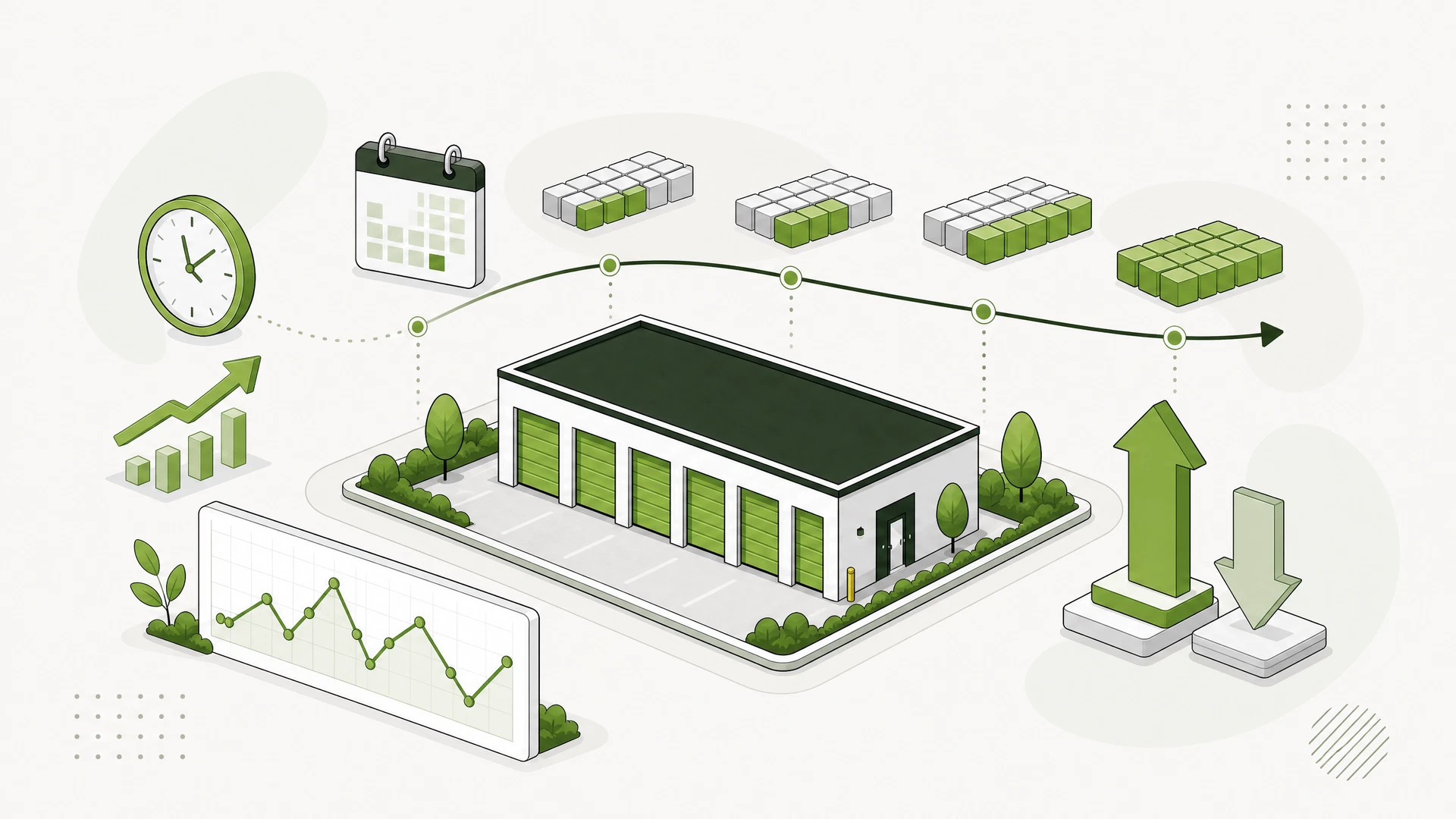
Self Storage Automation: The Complete Operator's Guide
A practical guide to self storage automation from someone who runs facilities and builds marketing tech. What to automate first, what to leave alone, and how automation should feed your marketing, not just your operations.

John Reinesch
Founder, StorIQ
On This Page
- What Self Storage Automation Actually Means
- The Table Stakes: What Every Automated Facility Needs
- Online Rentals and Reservations
- Digital Payments and Autopay
- Access Control
- Property Management Software
- Automated Communication
- The Second Layer: Where Most Operators Stop
- Self Service Kiosks
- Security and Environmental Monitoring
- Digital Documents and E-Signatures
- Unmanned and Remote Management
- The Gap: Automation That Feeds Your Marketing
- Move-In Attribution as a First-Class Feature
- Feeding Move-In Data to Ad Platforms
- Revenue Management as Marketing
- Multi-Channel Resilience
- The Phone Call Problem
- The Real Cost of Automation
- Automation Priorities by Stage
- Where StorIQ Fits
- Common Automation Mistakes
- What to Do This Quarter
I own three self storage facilities in Texas, Pennsylvania, and Illinois, and I run a marketing platform for the industry. That combination has forced me to think about automation from two angles that rarely get connected in the same conversation. Operators talk about automation as a way to cut labor. Marketers talk about it as a way to scale campaigns. Both are right, and both are missing the bigger point.
The real value of self storage automation is not just removing staff hours. It is creating a system where every customer touchpoint feeds clean data back into the machine that generates your next rental. Most operators automate the front end and leave the back end blind. This guide walks through what to automate, in what order, and how to make sure the whole stack actually compounds instead of just looking modern.
What Self Storage Automation Actually Means
At its core, self storage automation is using software, hardware, and integrations to handle repeatable tasks without human intervention. That covers everything from a tenant renting a unit at 2am on their phone to your gate opening when a delinquent account gets paid.
But the definition most operators use is too narrow. They think of automation as a checklist of features. Online rentals, autopay, smart locks, done. In practice, automation is a system where each piece talks to the others. When it works, a lead becomes a tenant becomes a data point becomes a better ad campaign, and none of it requires you to touch a spreadsheet.
According to Inside Self Storage data cited by Unwired Logic, about 25% of operators have implemented automation and another 58% plan to. That means the competitive advantage is real but shrinking. If you are in the 25%, you have a window. If you are in the 58%, you need a plan.
The Table Stakes: What Every Automated Facility Needs
Before we get into the interesting stuff, there are five components every automated facility runs. If you do not have these, start here.
Online Rentals and Reservations
A prospect should be able to find your facility, pick a unit, sign a lease, and pay without ever talking to you. This is not optional in 2025. The friction you leave on your rental page is the friction your competitor removed last year.
At one of my facilities in Pennsylvania, we tested a version of the site that required a phone call to complete the rental. Conversion dropped by roughly 40% overnight. The phone still matters, and I will get to that, but forcing the call is not the same as offering it.
Digital Payments and Autopay
Autopay adoption is one of the highest ROI things you can push. It reduces delinquency, cuts collections work, and improves tenant lifetime value because customers who set it and forget it stay longer. Every new lease at my facilities defaults to autopay. You can opt out, but you have to actively choose to.
Access Control
Smart locks, app based gate access, and unit level sensors have moved from novelty to standard. The value is not just convenience, it is data. You now know when a tenant is on site, how often, and whether their unit has been opened in the last 90 days. That data becomes useful when you start thinking about upsells and churn prediction.
Property Management Software
Your PMS is the spine. Storable, storEDGE, Easy Storage Solutions, Tenant Inc, or whatever you use, it needs to be the source of truth. Every automation you build depends on the PMS being accurate, connected, and API accessible. If you are on a system that does not open its data, replace it before you build anything else.
Automated Communication
SMS and email flows for lead nurture, welcome sequences, payment reminders, past due notices, and lien warnings. This is one of the fastest ways to cut administrative load. One operator I work with in a small Texas market cut their collections calls by more than half in the first 60 days after turning on automated past due sequences. Nothing fancy, just consistent messaging.
The Second Layer: Where Most Operators Stop
Once table stakes are in, the next layer is what separates a facility that automated tasks from a facility that automated a business.
Self Service Kiosks
Kiosks make sense in specific scenarios. Large facilities with walk in traffic, unmanned facilities, and rural markets where staffing is genuinely hard. They do not make sense as a substitute for a good website. Your website is your primary kiosk. Fix that first.
Security and Environmental Monitoring
Cameras with analytics, unit level door sensors, and climate monitoring for climate controlled units. The insurance implications alone often justify the spend. More importantly, you can catch problems before tenants do, which changes the review trajectory of your facility.
Digital Documents and E-Signatures
Paperless leases are standard. What is not standard is having those leases automatically archived, searchable, and tied to the tenant record with an audit trail. If your legal process still involves a filing cabinet, you are one lien dispute away from a bad afternoon.
Unmanned and Remote Management
A fully unmanned facility is possible today. I have looked hard at converting one of my smaller sites to unmanned and the math works in the right market. What kills unmanned facilities is not the tech, it is the failure to build multi channel resilience. If your kiosk goes down, does the call center know? If the call center misses, does the chatbot pick up? If the chatbot can't close, does the lead get routed to a human before it dies?
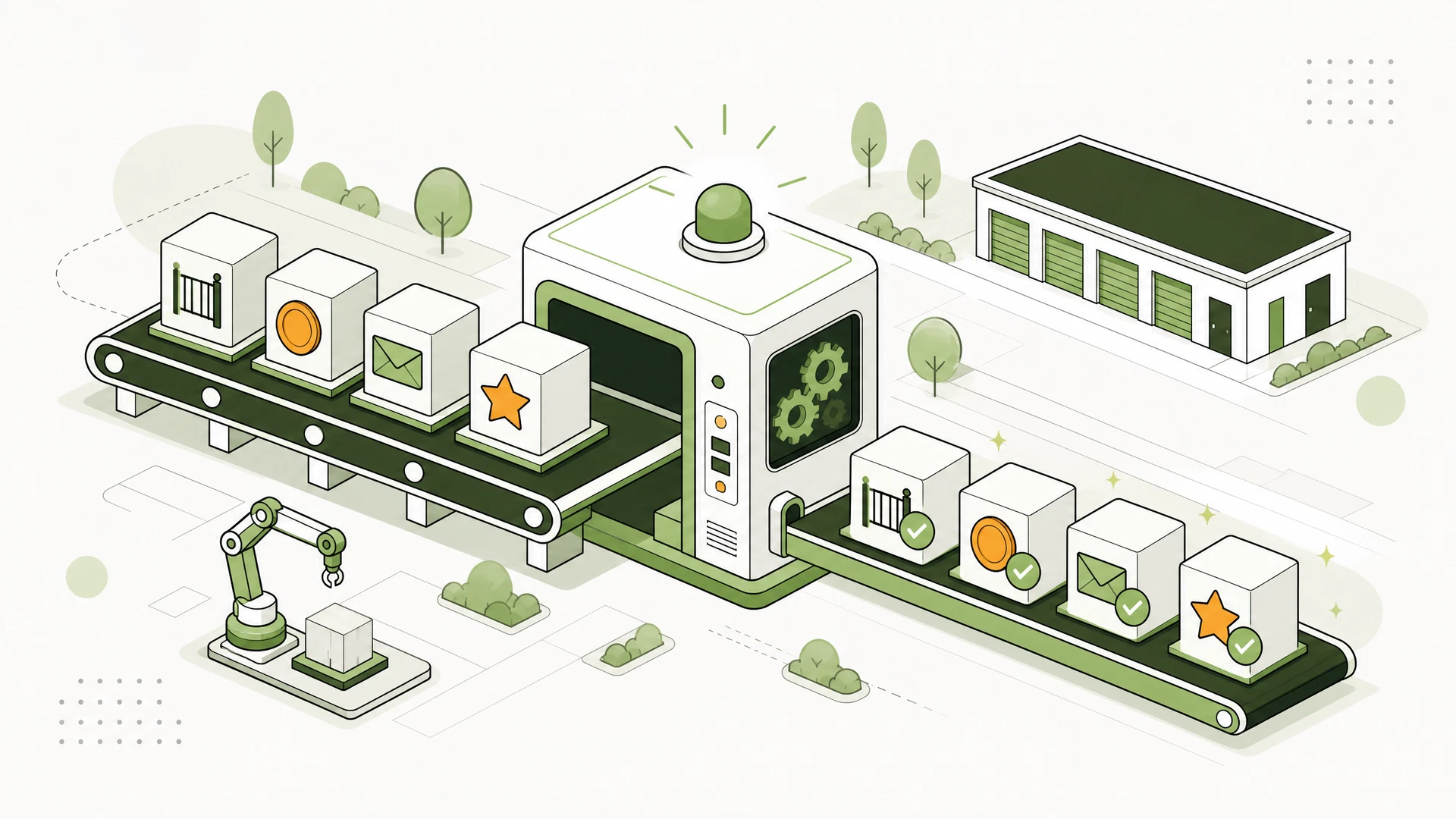
This is the part nobody writes about. Automation is not one system, it is a mesh. Every channel needs a fallback, and the handoffs between channels need to be tested like you would test a fire alarm.
The Gap: Automation That Feeds Your Marketing
Here is where most articles about self storage automation stop, and where the real money lives. Automating operations is table stakes. Automating the loop between operations and marketing is where you build a moat.
Move-In Attribution as a First-Class Feature
A lead is not a customer. A form fill is not a rental. Yet most operators optimize their marketing based on leads and form fills because that is what the ad platforms can see. This is backwards.
When a customer moves in, that event lives in your PMS. When they clicked the ad three days earlier, that event lives in Google Ads. Nobody connects them by default. If you want Google to optimize toward tenants instead of tire kickers, you have to send move-in events back into the ad platform as offline conversions. This is the biggest lever in paid media and almost nobody pulls it.
We built move-in attribution into StorIQ specifically because this gap was costing operators real money. Once Google Ads knows which clicks became rentals, not just which clicks became leads, the algorithm gets dramatically better at finding the next rental. I wrote more about this in a post on cost per move-in for Google Ads if you want to go deeper.
Feeding Move-In Data to Ad Platforms
This deserves its own section because it is the single automation that changes the economics of your marketing. Offline conversion tracking, enhanced conversions, and customer match sync all rely on one thing. Clean, timely move-in data flowing from your PMS to your ad accounts.
Set up correctly, this does three things. It teaches Google Ads to bid on the traffic that actually rents. It lets you build lookalike audiences from real tenants, not leads. It gives you a real cost per move-in number instead of cost per click or cost per lead, which are vanity metrics dressed up as performance data. Our PPC AI Agent does this automatically for the platforms we manage, but the concept is what matters, not the tool.
Revenue Management as Marketing
Most operators treat their street rate like a thermostat. Set it once, adjust when someone complains. This is a massive missed opportunity.
Your street rate is the most powerful marketing tool you own. Automated rate management lets you drop rates during low occupancy to drive volume, raise them during high occupancy to protect margin, and run existing customer rate increases on a schedule instead of when someone finally remembers. At one of my facilities we run ECRIs on a rolling basis triggered by tenant tenure and market rate deltas, all automated. That single change added meaningful revenue with zero incremental labor.
Revenue management belongs in the marketing stack, not the operations stack. When you frame it that way, it stops being an afterthought.
Multi-Channel Resilience
I mentioned this above but it deserves its own treatment. Automation fails when channels do not talk to each other. A customer who starts a rental on your website, gets confused, calls the phone number, and has to start over is a customer who is now shopping your competitor.
The fix is a unified data layer. Every channel writes to the same customer record. Every channel can pick up where another left off. When someone abandons a cart on the website, the call center sees the abandoned cart the moment they call. When someone rents at a kiosk, the CRM knows before the door closes behind them.
This is not futuristic. It is table stakes for any operator running more than five facilities. Below that scale, you can get away with looser integration, but you will pay for it in lost conversions.
The Phone Call Problem
More than 60% of storage customers call before they rent. Every automation strategy has to reckon with this, and most do not.
Automating the phone does not mean replacing humans with bots. It means routing calls intelligently, recording and scoring them, syncing call data to your PMS, and treating a call as a first class conversion event just like an online rental. Local Service Ads, call tracking, and AI call scoring are all part of this.
An AI call center can handle after hours and overflow, but the goal is not to eliminate the call. The goal is to make sure no call goes unanswered and every call generates data you can act on. I have seen facilities recover 15 to 20% more rentals just by fixing their call handling before touching their ad spend.
The Real Cost of Automation
Honest talk about money. Full automation is not cheap up front. Between PMS, access control, cameras, call tracking, marketing platforms, and integration work, a single facility can easily spend $15,000 to $40,000 to get properly automated, plus ongoing software costs of $500 to $2,000 per month depending on scale.
But the alternative is worse. Stora's guide cites data showing businesses that invest in technology see profit and performance improvements over 10%, and more than 68% of tech investing companies see revenue increases from e-commerce channels. In storage, where margins compound over years, that is the difference between a facility that sells for a good multiple and one that sells for a discount.
The operators who lose are the ones who buy the cheap version of everything. $150 a month SEO is a citation subscription. A free tier PMS is a data prison. A budget access control system is a lawsuit waiting to happen. Cheap vendors cost more than premium ones, always.
Automation Priorities by Stage
Not every facility needs every automation on day one. Here is roughly how I sequence it.
| Stage | Priority Automations | Why |
|---|---|---|
| Lease-up (0 to 70% occupancy) | Online rentals, autopay, lead nurture, call tracking, aggressive paid media | Volume beats efficiency. Remove every barrier to rental. |
| Fill-up (70 to 90%) | Move-in attribution, revenue management, review automation, ECRI schedule | Start optimizing. Data becomes actionable. |
| Stabilized (90%+) | Churn prediction, upsells, existing customer rate optimization, full multi-channel resilience | The money is in the gap between physical and economic occupancy. |
During lease-up, do not obsess over the perfect automated stack. You need move-ins, and volume beats efficiency every time. Once you cross 90%, the game changes. That is when the sophisticated automations pay off.
Where StorIQ Fits
Quick note on the tool I build, then back to strategy. StorIQ handles the marketing side of the automation stack. Google Ads management with move-in attribution baked in, Google Business Profile automation for reviews and posts, off-page SEO and citations, and a unified marketing intelligence dashboard that pulls FMS, ad platforms, GA4, and Search Console into one view.
It is not a PMS and it is not access control. It is the layer that connects your operational automation to your marketing automation, which is the layer most operators are missing. If you want to see how it works, book a demo. If not, take the concepts and apply them with whatever stack you use. The framework matters more than the tool.
Common Automation Mistakes
A few patterns I see over and over.
Automating before fixing tracking. Bad data in, bad results out. If your conversions are misfiring in Google Ads, automation will just help you waste money faster. Fix tracking first, always.
Buying the platform, ignoring the process. Software does not run itself. Someone still has to configure the flows, monitor performance, and iterate. The best PMS in the world will not save an operator who does not check reports.
Treating automation as a labor replacement only. The labor savings are real, but if that is the only ROI you measure, you will underinvest in the systems that actually grow revenue. Frame automation as a growth investment, not a cost cut.
Single vendor dependence. Building your entire stack on one vendor is fragile. Diversify your data pipes and integration points. If your PMS provider decides to sunset a feature you depend on, you want options.
What to Do This Quarter
If you are starting from zero, do these in order.
- Audit your current tech stack and identify what actually talks to what.
- Fix your conversion tracking. Every rental should fire back to every ad platform.
- Turn on autopay by default and automate your past due sequences.
- Set up review request automation. This is the highest ROI move for local SEO.
- Implement basic revenue management, even manual, and put ECRIs on a schedule.
- Build a simple attribution report that ties spend to move-ins by source.
Do not try to do everything at once. Automation compounds when it is layered, not when it is stacked in a rush.
Frequently Asked Questions
How much will it cost to automate one facility and what monthly budget should I plan for?+
What should I automate first to get the biggest impact in the next 60 to 90 days?+
How do I connect move ins back to Google Ads and why does that matter?+
Can I convert a site to unmanned management and what usually causes unmanned sites to fail?+
How long until automation reduces my collections and administrative workload?+
What are the most common automation mistakes and how do I avoid them?+
About the Author
John ReineschFounder, StorIQ
John is the founder and CEO of StorIQ, which handles Google Ads, local SEO, and attribution for self-storage operators across the US, Canada, and internationally. He also has ownership in three storage facilities across Texas, Pennsylvania, and Illinois, so he sees storage marketing from both the operator side and the agency side.