How to Start a Self Storage Business: An Operator's Playbook
I own three self storage facilities and run marketing for hundreds more. Here is the honest step by step for starting a storage business, including the lease-up math and pre-opening marketing plan most guides skip.

John Reinesch
Founder, StorIQ
On This Page
- Step 1: Do Real Market Research Before You Fall In Love With A Site
- Step 2: Build A Feasibility Model With Honest Numbers
- Step 3: Write A Business Plan You Would Actually Read
- Step 4: Line Up Financing
- Step 5: Decide Between Buy, Build, And Convert
- Step 6: Zoning, Permits, And Site Work
- Step 7: Design The Unit Mix And The Building
- Step 8: Choose Your Technology Stack
- Step 9: Build The Pre-Opening Marketing Plan (The Part Everyone Skips)
- Step 10: Model The Lease-Up Honestly
- Step 11: Design The Operating Model
- Realistic Expectations On Timeline And Returns
- Where StorIQ Fits
Self storage attracts first-time real estate investors for good reason. The industry is roughly $44 billion in the US, spread across about 52,000 facilities, and once a property stabilizes it tends to throw off predictable cash flow with a small operating team. Compared to multifamily or hospitality, the tenant relationship is light, the physical asset is simple, and technology has made remote operation genuinely viable.
Here is what almost every guide I have read gets wrong: they treat the story like it ends at the certificate of occupancy. Build the box, install the doors, hang a sign, and the customers show up. That was true in 1998. Today the business actually starts the day you break ground, because the map pack, your Google Business Profile, and your website need months of runway before your first move-in. I have watched brand new facilities sit at 20% occupancy a year after opening because nobody planned the marketing. I have also watched well marketed new builds hit 50% by month twelve.
I am going to walk you through the full path the way I wish someone had walked me through it before I bought my first facility. Ten steps, honest numbers, and the parts nobody talks about.
Step 1: Do Real Market Research Before You Fall In Love With A Site
Most first-time developers pick a site because it is available and cheap, then reverse engineer a story about why it will work. Do it the other way around. Start with a trade area, not a parcel.
Draw a three to five mile radius around any site you are considering. In rural markets stretch it to seven. Inside that radius you want to see:
- Population of at least 20,000 in a rural market, 50,000 to 100,000+ in suburban and urban markets
- Median household income in the middle to upper middle range for the region
- A resident age skew toward 20s through mid 50s, because that is when people move, downsize, divorce, inherit, and renovate
- Existing facilities running at 85%+ occupancy, which you can gauge by calling and asking about unit availability across sizes
- Square feet of storage per capita under about 8, ideally under 6
Drive-by traffic still matters a little, but a lot less than the guides claim. Most renters today pull out their phone, search "storage units near me," and pick from the top three results on the map. That is why local search visibility, which I cover in this guide to winning the map pack, matters more than a highway pylon sign.
Step 2: Build A Feasibility Model With Honest Numbers
Before you spend money on architects, build a simple pro forma. You are trying to answer one question: at stabilized occupancy, does this thing produce the returns I need?
Here are the ranges I use, pulled from published industry benchmarks and my own P&Ls:
| Line Item | Typical Range |
|---|---|
| Rent per sq ft per month | $0.50 rural to $4.00 urban |
| Target stabilized occupancy | 85% to 90% |
| Break-even occupancy | 60% to 70% |
| Operating expenses as % of revenue | 25% to 35% |
| Property tax as % of opex | 25% to 30% |
| Payroll as % of opex (traditional) | up to 38% |
| Investor cash on cash returns | 10% to 20% |
If the model only works at 95% occupancy and rent growth every year, it does not work. Stress test it at 80% occupancy and flat rents. If you still hit your debt service coverage, you have a real project.
Step 3: Write A Business Plan You Would Actually Read
Lenders want a plan. More importantly, you want a plan, because writing it forces you to answer questions you have been avoiding. Cover the market, the site, the competition, the unit mix, the construction budget, the operating model, the marketing plan, and the exit. Keep it 15 to 25 pages. Nobody reads 80 page business plans.
One thing to include that most first-timers leave out: a specific lease-up schedule with monthly occupancy targets and the marketing spend required to hit them. We will get to the math in step nine.
Step 4: Line Up Financing
The two most common paths for a first facility are SBA loans and conventional construction to permanent financing.
SBA 504 loans finance up to about $5 million of project cost with as little as 10% down for real estate, and the rates are usually competitive because part of the loan is government backed. SBA 7a is more flexible on use of funds but tends to price higher. Conventional construction loans typically want 25% down and roll into a permanent mortgage once you hit an occupancy or debt service milestone.
Banks care about three things: your liquidity, your experience, and the feasibility study. If you have never operated storage, partner with someone who has, or hire a third party feasibility firm whose report the bank recognizes.
Step 5: Decide Between Buy, Build, And Convert
This is the biggest strategic decision you will make.
Buying an existing facility gets you immediate revenue and known operating metrics. Small rural facilities can trade for $500,000 or less. Metro facilities can run north of $20 million. The risk is deferred maintenance, below-market rents you assumed you could raise easily, and sellers who cherry pick their trailing twelve months.
Ground up construction runs roughly $45 to $65 per square foot for single story non-climate, and $70 to $130+ per square foot for multi-story climate controlled. Total timeline from land acquisition to certificate of occupancy is usually 12 to 24 months. You get a modern, efficient building but you eat carrying costs during lease-up.
Conversion of an existing big box, warehouse, or industrial building can be the sweet spot in the right market. You get faster delivery than ground up, better economics than buying stabilized, and interior climate space that commands premium rents.
I have owned all three types. For a first-time operator with real capital, I usually recommend buying a small stabilized facility to learn the business, then developing your second one with the lessons in hand.
Step 6: Zoning, Permits, And Site Work
Even when a parcel is technically zoned for storage, you will run into setback requirements, landscape buffers, architectural review, stormwater management, and neighborhood opposition. Budget six to twelve months for entitlements in most jurisdictions. In restrictive markets it can take two years.
Before you go under contract on land, get a pre-application meeting with the planning department. Ask specifically about storage as a permitted use, height limits, and whether they have approved any storage projects recently. If the planner sighs when you say the word storage, walk away.
Step 7: Design The Unit Mix And The Building
Unit mix is where inexperienced developers overbuild the wrong sizes. The default mistake is too many 10x20 and 10x30 units because they feel valuable per square foot. In most markets, 5x10, 5x15, and 10x10 units lease faster, at higher price per square foot, and to stickier tenants.
Get a unit mix recommendation from a feasibility firm or a management consultant who has data from comparable markets. Then design the building around the mix, not the other way around.
While you are designing, think about the customer journey. Wide drive aisles. Well lit interior hallways. Cameras with real coverage, not decorative ones. A rentable office that can flex to unmanned operation. Your building is a physical extension of your brand.
Step 8: Choose Your Technology Stack
This is where new operators dramatically overpay or dramatically underinvest. You need three layers:
- A facility management system (FMS) to handle rentals, billing, gate control, and reporting. The major players are well documented in my self storage software guide.
- A website that actually converts search traffic into online rentals. Not a brochure site. See my breakdown of what a modern self storage website needs to do.
- A marketing intelligence layer that ties ad spend, calls, and web rentals to actual move-ins, so you know what is working. This is what I built StorIQ's Marketing Intelligence dashboard to solve.
For a first-time operator, I strongly recommend planning for a remote or unmanned operating model from day one. Kiosk, smart locks, call center backup, and a manager who visits a few days a week or covers several sites. Payroll is the largest single line of operating expense in the traditional model, often close to 38% of opex. Unmanned operation can cut that in half or better, and modern customers genuinely prefer the self serve experience.
Step 9: Build The Pre-Opening Marketing Plan (The Part Everyone Skips)
Here is the part I care about most, because it is where I see new operators leave a year of revenue on the table.
Google's map pack, the three business listings that show up when someone searches "storage units near me," is the single most valuable piece of digital real estate in this industry. Ranking there takes months of accumulated signals: a verified Google Business Profile, consistent citations, reviews, a fast local website, and on-page SEO targeting your city and unit types.
If you wait until opening day to start any of this, you are essentially invisible for your first six to nine months. That is exactly the period when carrying costs are highest and lease-up speed matters most.
Here is what I do at every new facility I am involved with, starting during construction:
- Register the LLC and phone number, and stand up a Google Business Profile as soon as the sign goes on the fence. Google allows pre-opening listings.
- Launch a real website with location pages, unit size pages, and pricing at least six months before opening. Read my self storage SEO guide for the on-page structure that works.
- Start collecting Google reviews from anyone legitimately involved: your GC, your contractors, your first waitlist customers. Reviews are the number one ranking factor in the map pack.
- Begin Google Ads about 60 to 90 days before opening to capture waitlist reservations. Yes, you will spend money before you have doors to open, and yes, it is worth it. My Google Ads guide and cost per move-in benchmarks explain what to budget.
- Set up move-in attribution reporting from day one so you can see which channels actually produce paying tenants, not just clicks.
The operators who do this open their doors with a waitlist of 40 to 100 pre-rented units. The ones who do not open their doors with an empty facility and hope.
Step 10: Model The Lease-Up Honestly
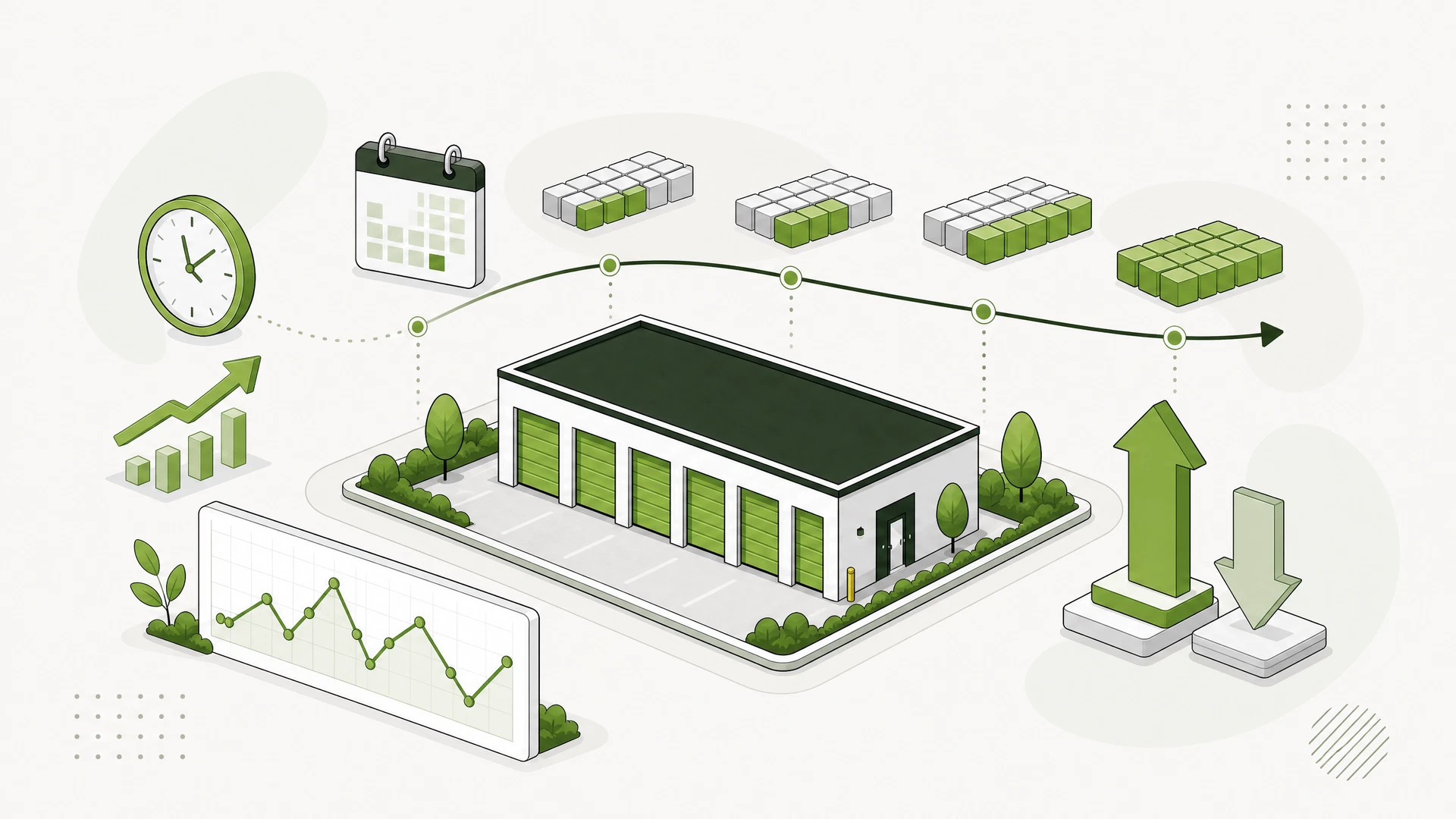
Here is the lease-up math nobody shows you. A well-marketed new build in a healthy market typically gains 3% to 5% net occupancy per month during active lease-up. That means 18 to 30 months to stabilization, not the 12 months your feasibility study probably assumed.
A simplified model on a 60,000 rentable square foot facility:
| Month | Occupancy | Monthly Revenue (approx) |
|---|---|---|
| 3 | 12% | $10,000 |
| 6 | 25% | $21,000 |
| 12 | 45% | $38,000 |
| 18 | 65% | $55,000 |
| 24 | 82% | $70,000 |
| 30 | 90% | $77,000 |
During those first 18 months you are paying full debt service, insurance, taxes, utilities, and marketing on partial revenue. That gap is what your construction loan interest reserve and your operating reserve are for. If you did not budget for it, you will be writing personal checks. This is the part of the business that ends careers.
Good marketing compresses that curve. Bad marketing stretches it. On a $6 million project, moving stabilization from month 30 to month 20 is worth several hundred thousand dollars in avoided carrying costs and captured revenue. That is the ROI on treating marketing like a core discipline instead of an afterthought.
Step 11: Design The Operating Model
Once you are open, storage is not passive. It is close to passive at stabilization if you set it up right, but the first two years require attention. Decide up front:
- Are you running unmanned, hybrid, or fully staffed?
- Who answers the phone at 8pm on a Saturday?
- Who handles delinquencies and auctions?
- Who audits the site weekly for broken locks, dead lights, and abandoned units?
- Who owns the marketing P&L?
Most first-time owners try to do all of this themselves and burn out around month nine. Decide which functions you keep and which you outsource. My self storage marketing overview and guide to choosing a marketing agency walk through what to hire out and what to keep in house.
Realistic Expectations On Timeline And Returns
Here is the honest timeline for a ground up development:
- Site selection and due diligence: 2 to 4 months
- Entitlements and permits: 6 to 12 months
- Financing close: 2 to 3 months (overlapping)
- Construction: 8 to 14 months
- Lease-up to stabilization: 18 to 30 months
Total: three to five years from first offer to stabilized operation. Investor cash-on-cash returns at stabilization commonly land in the 10% to 20% range depending on leverage, market, and how well you run the business. If someone is pitching you 30%+ returns on a new development, ask harder questions.
The operators who do best treat storage as a real business, not a passive investment. They know their cost per move-in, their occupancy by unit size, their web traffic, and their competitor pricing. They market during construction, not after. They pick technology that scales.
Where StorIQ Fits
I built StorIQ because I was tired of running my own facilities without knowing which marketing dollars actually produced move-ins, and because the operators I talked to had the same problem at ten times the scale. Our AI agents handle Google Ads and Google Business Profile optimization, and our marketing intelligence dashboard ties every call, click, and lead back to actual paying tenants. If you are opening your first facility, or your fifth, and want a marketing engine ready to go on day one, book a demo or take a look at pricing. Either way, start the marketing during construction. That single decision changes the economics of your first two years more than almost anything else you will do.
Frequently Asked Questions
How much does it cost to start a self storage business?+
How long does it take to build and lease up a new self storage facility?+
Is self storage still a good business to get into?+
Should I buy an existing self storage facility or build one?+
What is the biggest mistake first-time storage operators make?+
Do I need to be onsite to run a self storage facility?+
About the Author
John ReineschFounder, StorIQ
John is the founder and CEO of StorIQ, which handles Google Ads, local SEO, and attribution for self-storage operators across the US, Canada, and internationally. He also has ownership in three storage facilities across Texas, Pennsylvania, and Illinois, so he sees storage marketing from both the operator side and the agency side.