Self Storage Sign Ideas: Examples That Attract Renters
The self storage sign ideas that actually generate move-ins, with real examples, cost ranges, and a framework for tracking which signs pay for themselves.

John Reinesch
Founder, StorIQ
On This Page
- Why Signage Deserves a Real Marketing Budget
- The Exterior Signs Every Facility Needs
- Monument Signs
- Pylon and Pole Signs
- Building Fascia and Channel Letters
- Wayfinding and Entrance Signage
- Design Principles That Actually Convert
- Readability at Speed
- Contrast and Color
- Consistent Branding
- Electronic Message Centers and Digital Displays
- Revenue Management as Marketing
- Compliance and Permits
- Interior and Wayfinding Signage
- The Essentials
- ADA Requirements
- Lighting: The Multiplier on Every Sign You Own
- The Gap Nobody Fills: Tracking Sign Performance
- Use Dedicated Phone Numbers
- Custom QR Codes
- Feed Move-In Data Back to Ad Platforms
- Signage as a Hedge Against Rising CPCs
- Budget-Friendly Signage Ideas That Still Work
- Vinyl Banners
- A-Frames and Yard Signs
- Wrapped Fencing and Gate Panels
- Vehicle Wraps
- Maintenance and Refresh Cycles
- Putting It All Together
Signage is one of the few marketing investments in self storage that keeps working while you sleep, while Google changes its algorithm, and while your PPC agency is on vacation. It is also one of the most misunderstood line items in the business.
Most operators treat signs like a construction cost. Buy them once, install them, forget them. That mindset leaves money on the table. At my three facilities in Texas, Pennsylvania, and Illinois, and across the operators we work with at StorIQ, signage consistently ranks as a top-two customer acquisition channel alongside organic search. According to Storage Commander data cited by StorageOwnerAdvisor, roughly 80% of self storage customer acquisition comes from a combination of organic web search and drive-by visibility. That means half of your new tenants are being influenced by what your building looks like from the road.
This guide covers the signage types every facility needs, the design choices that actually convert, and the parts almost no one talks about: how to track which signs drive move-ins, how to use digital signs as a revenue management tool, and how to feed that offline data back into your paid ads.
Why Signage Deserves a Real Marketing Budget
A sign is not a decoration. It is a 24/7 billboard sitting on the most expensive piece of real estate you own, the corner closest to the road.
Asset Growth research cited by StorageOwnerAdvisor found that 37% of people report looking at a sign every single time they pass one. If your facility is on a road with 15,000 vehicles per day, that is roughly 5,500 daily impressions before you spend a dollar on Google Ads. Compare that to what you would pay for the same reach on paid channels and the math gets serious fast.
There is also a strategic angle most operators miss. Single-channel dependence is a liability. If your entire lead flow runs through Google, one algorithm update or one competitor with deeper pockets can gut your occupancy in a quarter. Physical signage is one of the few channels Google cannot take away from you. Build it, maintain it, and it becomes a stable lead source that supports everything else in your self storage marketing plan.
The Exterior Signs Every Facility Needs
Before we get into creative ideas, let's cover the four exterior sign types that show up on almost every high-performing facility.
Monument Signs
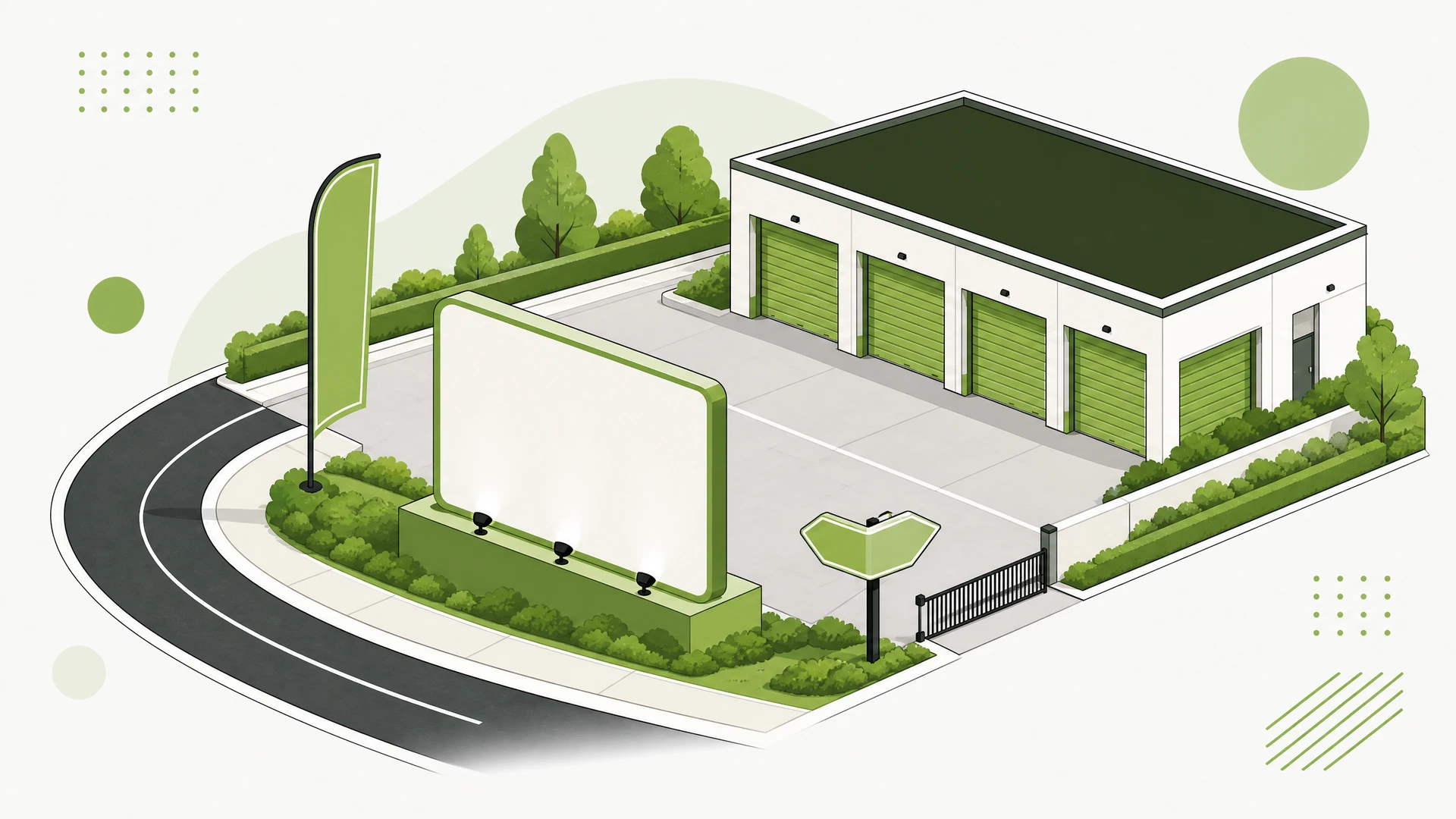
A monument sign sits low to the ground, usually on a masonry or stone base, at your main entrance. It is the sign that says "you have arrived."
Monument signs typically run $8,000 to $25,000 depending on size, materials, and whether you add an electronic message center. They work best on roads where traffic moves at 35 mph or less and drivers have time to read them.
Pylon and Pole Signs
Pylon signs are the tall ones you see from the highway. If your facility sits back from a fast-moving road, a pylon sign is not optional. It is the difference between being found and being invisible.
Expect to pay $15,000 to $60,000 for a well-built pylon sign, more if you add double-sided EMCs. Check your zoning first. Many municipalities cap pylon height at 25 or 35 feet, and some prohibit them entirely in mixed-use zones.
Building Fascia and Channel Letters
Channel letters mounted on your building fascia do the heavy lifting once drivers are within a block of your facility. They confirm the brand and reinforce the monument or pylon sign.
Illuminated channel letters are worth every dollar. A dark building at night reads as closed, unsafe, or abandoned. LED-illuminated letters solve that in one purchase.
Wayfinding and Entrance Signage
Once a customer turns into your lot, wayfinding signs take over. Office, rentals, gate access, drive lane arrows, and unit building identifiers all fall into this category. These signs are cheap relative to their impact. Bad wayfinding creates confused customers who call your office asking basic questions, which eats staff time and tanks the rental experience.
| Sign Type | Typical Cost Range | Primary Purpose | Best For |
|---|---|---|---|
| Monument | $8K to $25K | Facility identification | Slower roads, main entrance |
| Pylon | $15K to $60K | Long-distance visibility | Highway-adjacent, set-back lots |
| Fascia / Channel Letters | $5K to $30K | Building identification | Confirming brand up close |
| EMC / Digital Display | $10K to $40K add-on | Dynamic messaging | Promotions, pricing, scarcity |
| Wayfinding | $200 to $2K each | Navigation on site | Every facility, no exceptions |
Design Principles That Actually Convert
I have seen operators spend $30,000 on a sign that no one can read. Design matters more than budget.
Readability at Speed
The number one rule: your sign must be legible from the distance and speed drivers are moving. A good rule of thumb is one inch of letter height for every 25 feet of viewing distance. If your monument sits 100 feet from the road, your letters need to be at least four inches tall. On a pylon sign viewed from 400 feet, you need 16-inch letters minimum.
Simple sans-serif fonts win. Skip the script and the ultra-thin weights. If a driver has to squint, you have already lost them.
Contrast and Color
High contrast reads faster than pretty color palettes. Dark text on a light background, or light text on a dark background. Anything in between is a compromise.
Brand colors matter, but readability matters more. One operator we work with in a small Texas market repainted their monument sign from a muted tan-on-cream palette to a bold navy background with white letters. Calls from drive-by traffic increased noticeably within 60 days according to their call tracking data.
Consistent Branding
Your monument, pylon, fascia, and website should all look like they belong to the same business. Same logo, same colors, same fonts. When customers Google your name after seeing your sign, and roughly 60% of them do before calling, the website needs to confirm the brand they just saw. This is where good self storage website design and signage decisions have to be made together.
Electronic Message Centers and Digital Displays
EMCs are the highest-leverage upgrade most facilities can make. A well-placed EMC does three things a static sign cannot: it drives urgency, supports revenue management, and lets you test messaging without reprinting anything.
Revenue Management as Marketing
Here is a POV that runs against how most operators think: your street rate is the most powerful marketing tool you own. An EMC lets you use it in real time.
"$29 First Month, 10x10 Climate Controlled" is a promotion. "Only 2 Climate Units Left" is scarcity. Rotating these messages based on real occupancy in your management software creates urgency that a static sign never can. At one of my facilities in Pennsylvania, we rotate EMC content based on unit-type occupancy. When a size category hits 92%, the message shifts to scarcity. When it drops below 80%, it shifts to promotional pricing.
This is what I mean when I say revenue management is marketing. The sign is not just advertising rates, it is enforcing them.
Compliance and Permits
Before you buy an EMC, check your municipality's sign code. Many cities regulate brightness, message dwell time (usually 6 to 8 seconds minimum), and animation. Some prohibit EMCs entirely in certain zones. A $25,000 sign you can't turn on is an expensive lesson.
Interior and Wayfinding Signage
Interior signage does not drive move-ins directly, but bad interior signage kills the customer experience and generates support calls.
The Essentials
- Unit numbers: Large, high-contrast, visible from a distance. Reflective vinyl works well in low-light hallways.
- Building identifiers: A, B, C or 100s, 200s. Make them visible from the drive lane.
- Directional arrows: At every intersection in your drive aisles.
- Office and rental signs: Obvious from every entrance point.
- Gate access instructions: At the keypad, in clear language, with your phone number.
- Hours of operation: On the office door, on the gate, and on the website.
ADA Requirements
ADA compliance is not optional. Signs identifying permanent rooms (office, restroom, exit) need tactile characters and Grade 2 Braille. They must be mounted 48 to 60 inches from the floor to the baseline of the lowest tactile character, on the latch side of the door. Non-compliant signage is a real liability exposure, and the cost to do it right is minimal.
Lighting: The Multiplier on Every Sign You Own
A sign that is not lit at night is a sign that works 12 hours a day instead of 24. In self storage, where late-evening and weekend traffic drives a huge share of inquiries, that is a lot of missed impressions.
Radius+ data cited by StorageOwnerAdvisor shows that upgrading from fluorescent or HID lighting to commercial LED reduces energy usage by 60% to 90%, with typical payback in 2 to 4 years. There are also tax incentives worth checking with your accountant, including the 179D deduction for qualifying commercial energy upgrades.
Beyond ROI, better lighting improves security camera footage, deters crime, and makes the facility feel safe to customers arriving after dark. A woman renting a unit at 8 pm in November is looking at your lighting whether she realizes it or not.
The Gap Nobody Fills: Tracking Sign Performance
Here is where almost every article on this topic falls short. They tell you what signs to buy but never how to measure whether they worked.
Move-ins are the only metric that matters. Everything else is noise. If you cannot connect your signage spend to actual move-ins, you are guessing.
Use Dedicated Phone Numbers
The simplest tracking method is a dedicated call tracking number on your monument or pylon sign. Every call to that number gets logged, recorded, and attributed to signage. If you run a promotional banner, use a different number on the banner. Now you can compare monument-driven calls to banner-driven calls to Google Ads-driven calls.
Around 60% of storage customers call before they rent, so the phone is still where most conversions actually happen. Tracking calls is tracking move-ins, as long as your call handling is solid.
Custom QR Codes
QR codes are back. Every smartphone camera reads them natively now, and adoption has never been higher. Put a unique QR code on each major sign that links to a landing page with a tracking parameter. When someone scans your monument QR code and rents, that move-in is attributable to the monument.
Feed Move-In Data Back to Ad Platforms
This is the piece almost nobody does, and it separates operators who compound gains from operators who spin in place.
When a customer sees your sign, calls, and rents, that move-in should not just sit in your management software. It should be exported and uploaded back into Google Ads and Meta as an offline conversion. The algorithms use that data to find more people who look like the customer who actually rented.
The biggest lever in Google Ads isn't bids or keywords, it is the data you feed it. Pipe real move-ins back into the platform and you teach Google to find tenants instead of leads. This is exactly what our PPC AI Agent automates for operators, and it is why unified marketing intelligence matters. You can read more about this attribution loop in our post on move-in attribution reporting.
Signage as a Hedge Against Rising CPCs
One more strategic point. Google Ads CPCs in self storage have climbed steadily for years. In competitive metros, cost per click on branded terms alone can exceed $15. REITs win that auction because their lifetime value lets them outbid everyone. Whoever can afford to spend the most to acquire a customer wins.
Strong physical signage is one of the few ways independent operators can level that playing field. A driver who sees your monument sign, calls the number, and rents cost you the amortized price of the sign plus nothing. That customer never entered the Google Ads auction. Every sign-driven move-in is a move-in the REITs cannot buy away from you.
This is what I mean by build channel two and three before you need them. Signage, local SEO, and organic search need to be humming before Google Ads becomes unaffordable, not after.
Budget-Friendly Signage Ideas That Still Work
Not every operator has $60,000 for a new pylon. Here are lower-cost sign ideas that still move the needle.
Vinyl Banners
A well-designed 4x8 vinyl banner runs $150 to $400. Rotate them seasonally: "Move In Special," "Boat & RV Storage Available," "New Climate Units Now Open." You can design them yourself in Canva or Adobe Express in an afternoon.
A-Frames and Yard Signs
Place them at the entrance, at nearby intersections where zoning allows, and on the street-facing corner of your property. Cheap, easy to update, and effective for time-sensitive promotions.
Wrapped Fencing and Gate Panels
Mesh fence wraps or vinyl panels on your perimeter fencing turn a boring chain link into a marketing surface. Especially valuable on corner lots.
Vehicle Wraps
If you own a facility truck or golf cart, wrap it. That vehicle becomes a mobile sign every time it moves.
Maintenance and Refresh Cycles
A faded, cracked, or burned-out sign does more damage than no sign at all. It signals a neglected facility, and customers extrapolate.
Plan on the following cycles:
- Wash and inspect: Quarterly
- Bulb and LED module replacement: As needed, checked monthly at dusk
- Vinyl and printed panel refresh: Every 3 to 5 years, sooner if faded
- Full sign refresh or repaint: Every 7 to 10 years
- EMC firmware and content review: Quarterly
Putting It All Together
Self storage signage is not a one-time construction expense. It is an ongoing marketing channel that deserves the same rigor as your Google Ads account.
Start with the fundamentals: a readable monument or pylon, illuminated fascia, clear wayfinding, and ADA-compliant interior signs. Layer in an EMC when you can support it operationally, and use it to drive urgency and support revenue management. Track everything with dedicated phone numbers and QR codes so you know which signs actually produce move-ins. Then feed that data back into your paid ad platforms to compound the results.
Marketing is a system, not a pile of tactics. Signage is one pillar of that system. Get it right and it keeps working for a decade. Get it wrong and you are paying for a very expensive decoration.
Frequently Asked Questions
How big do the letters on my storage sign need to be?+
Is signage really worth the investment compared to Google Ads?+
How do I use an EMC to support revenue management?+
What is the ROI on upgrading to LED sign lighting?+
What is the biggest mistake operators make with signage tracking?+
What are some low-cost signage options for a tight marketing budget?+
About the Author
John ReineschFounder, StorIQ
John is the founder and CEO of StorIQ, which handles Google Ads, local SEO, and attribution for self-storage operators across the US, Canada, and internationally. He also has ownership in three storage facilities across Texas, Pennsylvania, and Illinois, so he sees storage marketing from both the operator side and the agency side.